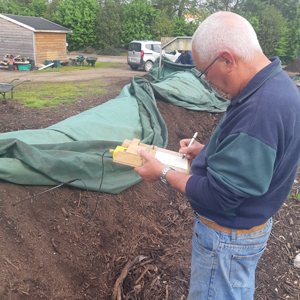
Hello Doctor, why are you taking the temperature of the Compost?
Monitoring the temperature of the compost is an important step towards successful composting.
- The temperature of the compost gives an indication of the progress of the organic waste decomposition process.
In general, the temperature of the compost rises when the micro-organisms responsible for decomposition are active. - The ideal temperature for fast, efficient composting is between 55 and 65 degrees Celsius.
If the temperature is too low, decomposition will be slower and unpleasant odours may appear.
If the temperature is too high, it can kill off the micro-organisms needed for decomposition. - By monitoring the temperature of the compost, you can adjust the carbon/nitrogen (C/N) ratio.
If the temperature is too low, add nitrogenous waste (vegetable scraps or coffee grounds).
If the temperature is too high, you add carbonaceous materials (dead leaves or wood shavings). - The temperature of the compost can be used to identify potential problems, such as cold or dry areas in the compost.
In cold areas, mix the compost to help distribute the waste evenly.
In dry areas, you add water to increase the moisture content.
To measure the temperature, I use a specially designed compost thermometer.
I insert it into the compost and wait a few minutes to get an accurate reading.
The data collected each Saturday is then sent to the Communauté de Communes.