People sometimes say Grosbreuil is one of those villages you drive through at nightfall without meeting a living soul. Shutters closed, quiet streets, and everyone at home over a bowl of soup.
Not a chance! This Monday evening, the Compostons Ensemble committee tried to book a room for an urgent meeting. The answer: everything was taken. Not a single free room, not even a corner of a table. Grosbreuil does not sleep in the evening: open a few doors and you will see for yourself.
A quick tour of the open doors
Yoga
Gym
Pilates
Theatre
Arts and crafts
Basketball
Badminton
Archery
Music
Behind one door, people are breathing deeply: that's yoga. Next door, they are working up more of a sweat: gym and Pilates keep the winter tummy at bay. Further along, lines are being rehearsed and entrances polished: it's theatre night.
Elsewhere, scissors, brushes and glue are busy at arts and crafts. The ball bounces at basketball, the shuttlecock flies at badminton, and arrows fly straight at archery. And somewhere, notes drift out of a music room.
In short, night may fall early in Grosbreuil in November, but the lights in the village halls stay on. Well done to all the associations that keep the village alive: it is excellent news… unless you are looking for a room!
And what about us?
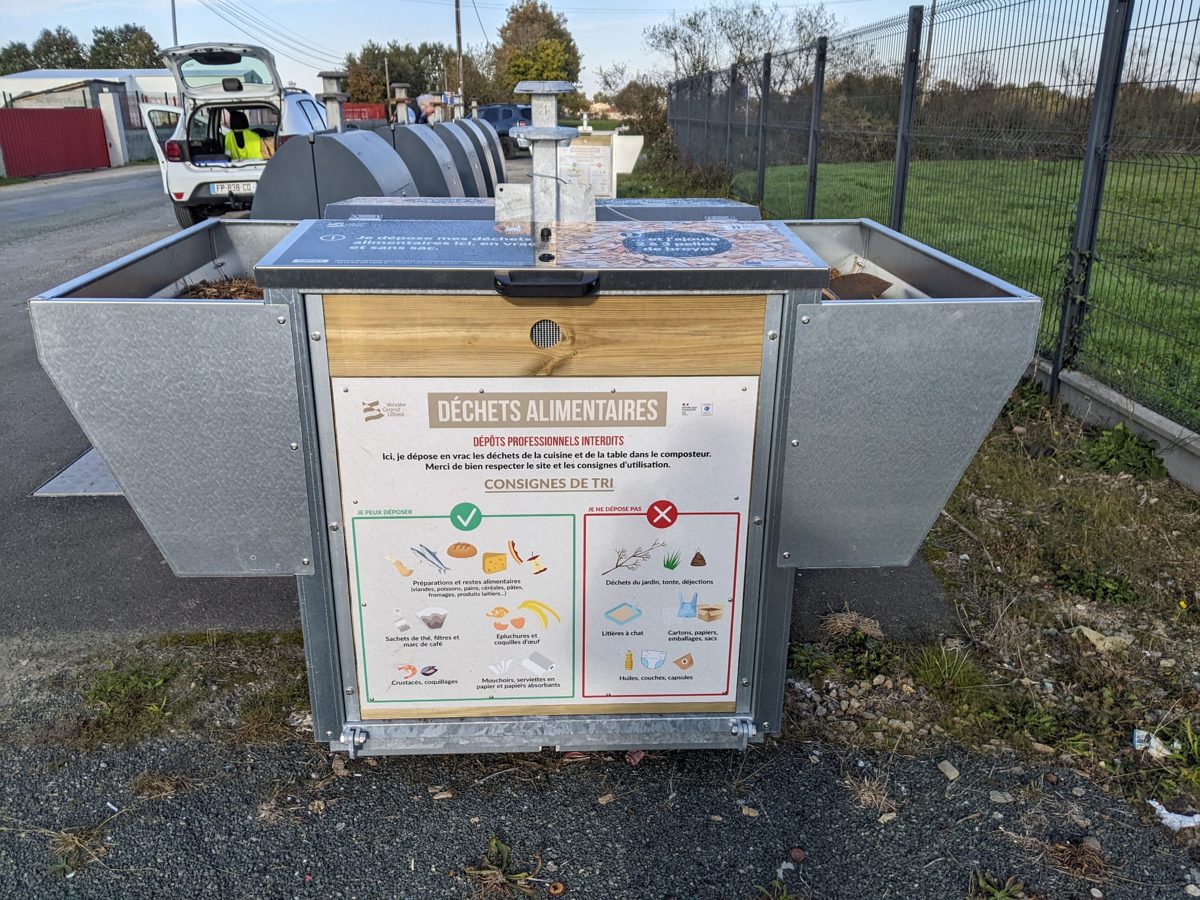
We needed a room, and fast! The committee had to meet quickly about the famous new food waste collectors that have just landed on the route de la Luctière, right next to the recycling drop-off points. You may have spotted them: large metal units that arrived without warning, rather like flying saucers.
One evening, on the route de la Luctière… (Compostons Ensemble animation, 19 seconds, with sound)The new food waste collector on the route de la Luctière.
They raise quite a few questions for our association, which has been composting the kitchen waste of Grosbreuil's residents since 2009. We will tell you more very soon, promise.
Luckily, the town hall came to the rescue! The mayor, Marc Hillairet, together with Laurent Enfrin, fourth deputy mayor, welcomed us into the old schoolroom of the Maison du Patrimoine in Grosbreuil. Many thanks to them. Meeting on school benches to talk about compost: you have to admit, there are worse settings!
So next time someone tells you Grosbreuil goes to sleep at nightfall, you will know what to say: just try booking a room!
Come and see us at the composting site
Drop-in sessions on Wednesdays and Saturdays, 10 am to 12 noon, rue des Lavandières. Coffee, advice and good humour included!
After the hottest summer ever recorded, our greenhouse and vegetable garden need a new instruction manual. Our grandparents' calendar no longer works: rain now falls mostly in winter, spring is dry and heatwaves arrive in June. Everything suggests the coming years will look like this one: it is highly likely that we will have to adapt… and we must start now. Here is a calendar to help us prepare, from October to September, in the garden and in the greenhouse. Feel free to use it in your own garden!
☀️ What the last 12 months taught us
Winter is the water season. February 2026 was very wet and very mild, while autumn 2025 had stayed dry.
Spring has become dry. Almost 40% less rain than usual in La Roche-sur-Yon between March and May.
The "Ice Saints" are no longer a threat. Since 2005, these mid-May days (11–13 May) have only brought real frost once, in 2010. Here, the last frost now tends to come in March or early April.
Summer starts in June. June 2026 was the hottest ever recorded in France, and the whole of Vendée was placed on water alert at the end of June.
⚠️ Key point: in Vendée, almost all tap water comes from reservoirs. Summer restrictions should now be expected every year, with watering of vegetable gardens banned between 8 am and 8 pm.
🌱 Our 6 rules for gardening differently
1. Bring summer forward
Tomatoes, courgettes and beans go in at the end of April under fleece, so they are well rooted before the heatwaves.
2. Take a break in July–August
Harvest, provide shade, plant almost nothing. The second season starts again in the greenhouse at the end of August.
3. Never leave soil bare
Compost in autumn, green manures in winter, 10–15 cm of mulch from April.
4. Store winter water
1 m² of roof × 1 mm of rain = 1 litre. Tanks must be filled between December and March.
5. Water little, deep, at dawn
Drip irrigation or ollas under the mulch, between 5 and 8 am. In the greenhouse, avoid evening watering: the moisture stays trapped on the leaves all night, which is exactly what blight needs to develop. Watered at dawn, everything dries out during the morning.
Late April: tomatoes, courgettes, squash, beans under fleece
May
Top up the mulch
Put up shade netting (30–50%), open fully
Second sowing of beans, sweet potatoes, leeks in a nursery bed
June
Water only at the base of plants
Permanent shade, watering at dawn
Harvest broad beans, peas, early potatoes, garlic; transplant leeks
July
Do not dig; keep the soil covered
Harvests; cover freed-up space
Harvests; winter carrots and beetroot in the shade
August
Prepare the second season: compost + mulch
Late August: sow cabbages, lettuce, chard, fennel
Turnips, winter radishes, spinach after a storm
September
Compost on freed-up beds
Plant out August sowings; lamb's lettuce
Cabbages, leeks, lettuce as soon as the rain returns
Good to know: the greenhouse is 5–10 °C warmer than the garden. In spring, everything happens there 3–4 weeks earlier.
🍅 When to plant what? The new dates
The old rule "plant after the Ice Saints" becomes: end of April, under fleece, ready to be covered if a cold night is forecast.
Vegetable
Planting out
Before
Climate tip
Tomato
20–30 April (greenhouse: early April)
after 15 May
Small-fruited varieties; beefsteaks in a shaded greenhouse
Courgette
20–30 April
mid-May
Two plants are enough; very thick mulch
Squash, pumpkin
late April–early May
late May
Trailing varieties shade the soil
Bean
20 April–15 May, then late July
May–June
Climbing and borlotti types cope better
Chilli, pepper
early May
late May
They love heat: tomorrow's allies
Potato
late February–March
April
Harvested before the hot spells
Broad beans, peas
late October–November
March
Sown in autumn, harvested before the drought
Garlic, shallot
October–November
February–March
Autumn planting is much safer
Winter cabbages
sow late August, plant late September
sow in June
June sowings no longer survive the heat
The real signal for summer vegetables: soil above 12 °C in the morning. A soil thermometer costs just a few euros!
💧 Our water plan: how many tanks do we need?
Our greenhouse is about 15 m² and we have two 1,000-litre tanks. With mulch and drip irrigation, we estimate the June–August need at about 1,200 litres for the greenhouse and 3,900 litres for the garden, around 5,100 litres in total. The greenhouse roof can collect about 3,600 litres over the winter.
Extra tanks
Total storage
Summer need covered
What it takes
None (today)
2,000 L
39%
Greenhouse covered, garden barely
+1
3,000 L
59%
The greenhouse roof is enough
+2
4,000 L
78%
Greenhouse roof + spring rain
+3
5,000 L
98%
A second roof of at least 6 m² (shed, cabin)
Our goal: add one or two tanks this winter, linked in series, covered against mosquitoes, and kept first for the greenhouse and tomatoes. The rest of the garden will rely on thick mulch and early planting.
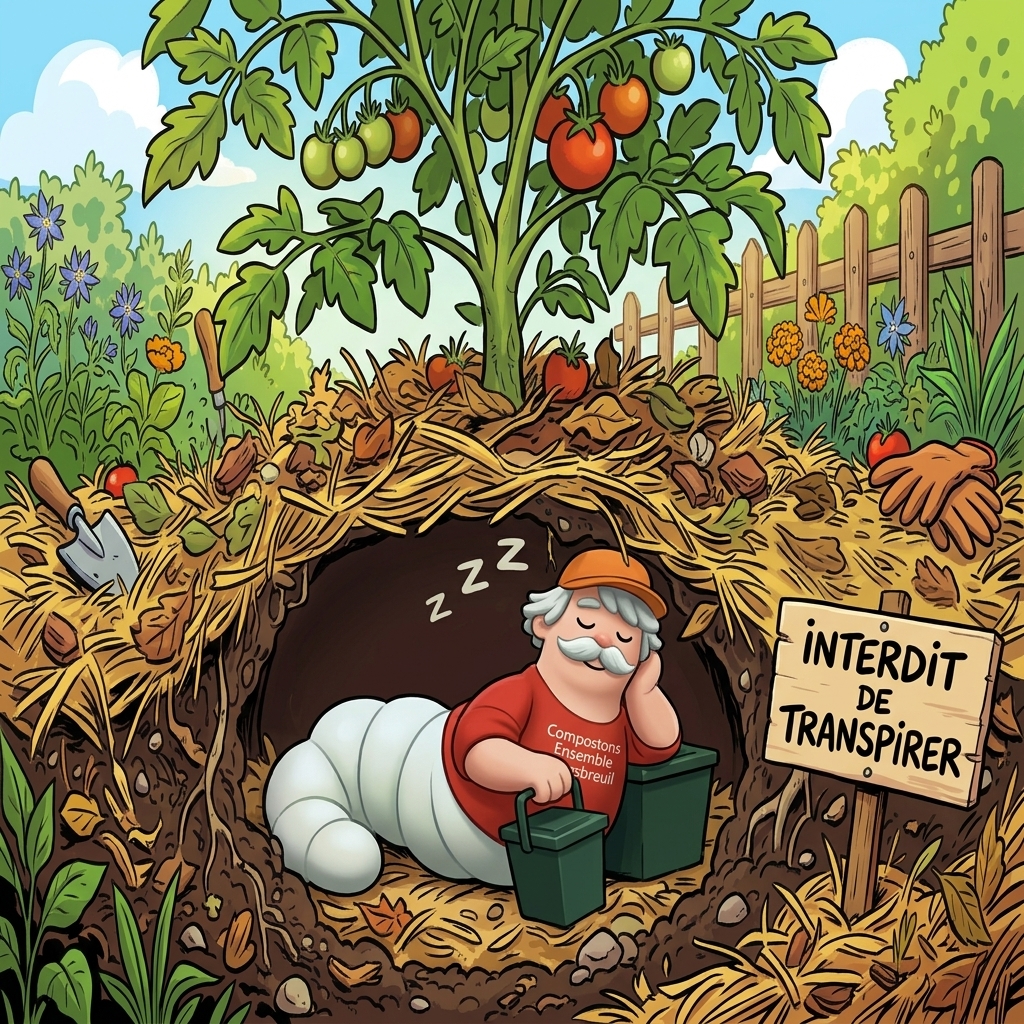
Hector follows his own advice: during a heatwave, a nap under the mulch is compulsory! (The sign says "No sweating allowed".)
"I never drink in the middle of the afternoon: I go down into the cool under the straw and wait for dawn. Do the same with your tomatoes!" — Hector, gardening earthworm and water-saving expert
🤝 Can you lend a hand?
Do you have an IBC tank (1,000 L) gathering dust in a barn, a spare length of gutter, or a few hours to help us install them this winter? Come and see us at the composting site, Wednesdays and Saturdays, 10 am to noon, or get in touch.
Weather sources: Météo-France Pays de la Loire monthly climate bulletins (November 2025 to May 2026), Météo-France summer 2026 review, Vendée prefectoral order of 29 June 2026.
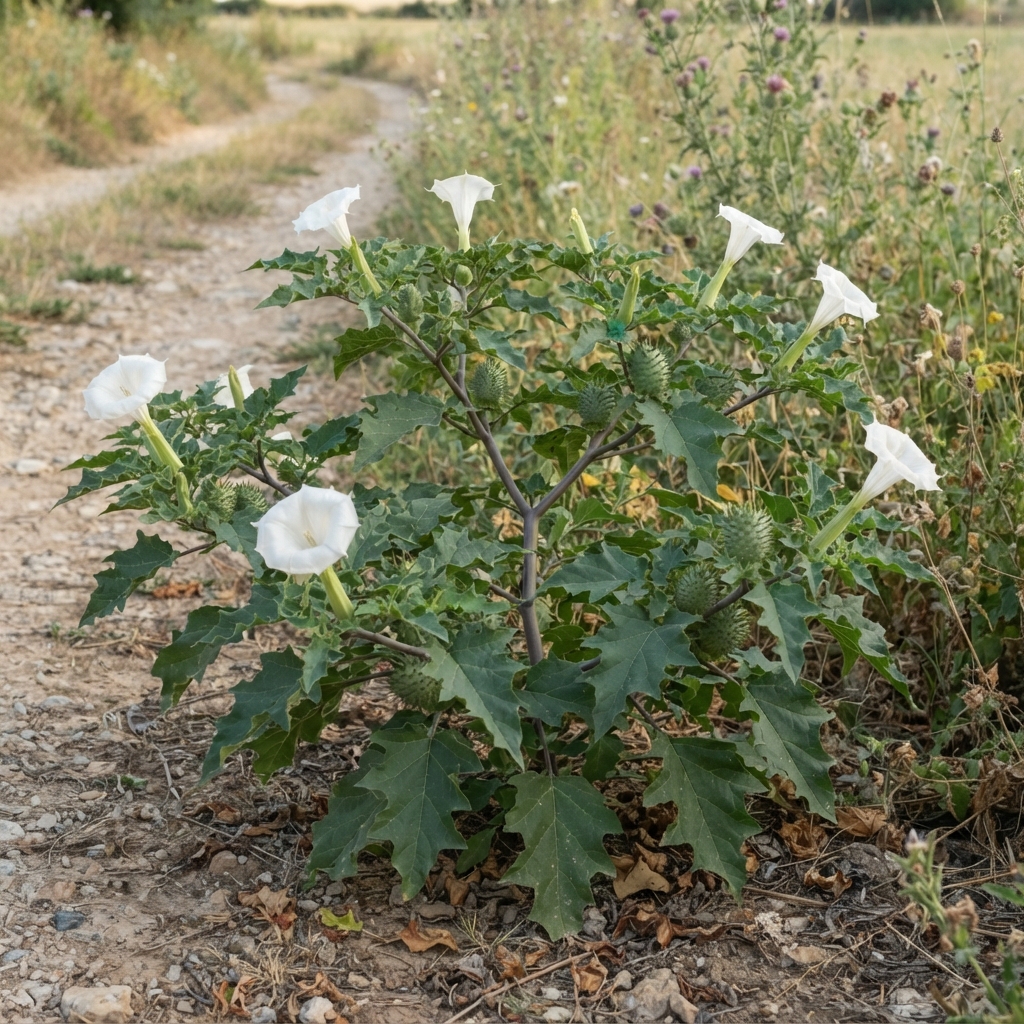
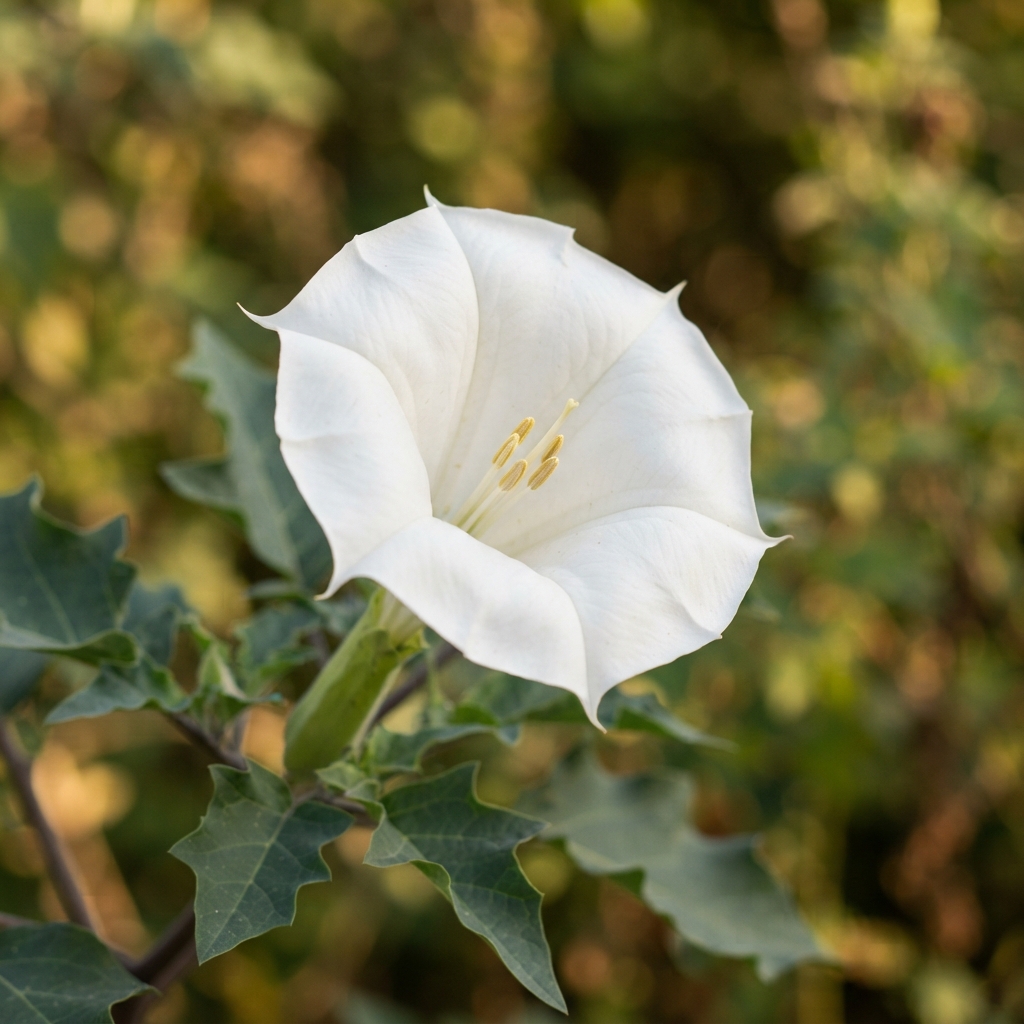
Large white trumpet-shaped flowers, a sweet scent at dusk… and one of the most poisonous plants in our countryside. Meet datura, a "lady of the night" that loves neglected ground.
Why are we talking about it now?
You may not have noticed yet, but the Grosbreuil composting site is expanding! It is taking over part of the neighbouring wastewater treatment plant. Great news for the association… with one small catch: the new plot is covered with freshly disturbed, bare soil, exactly the kind of ground where datura loves to settle.
So before we put our gloves on, let's get to know the enemy.
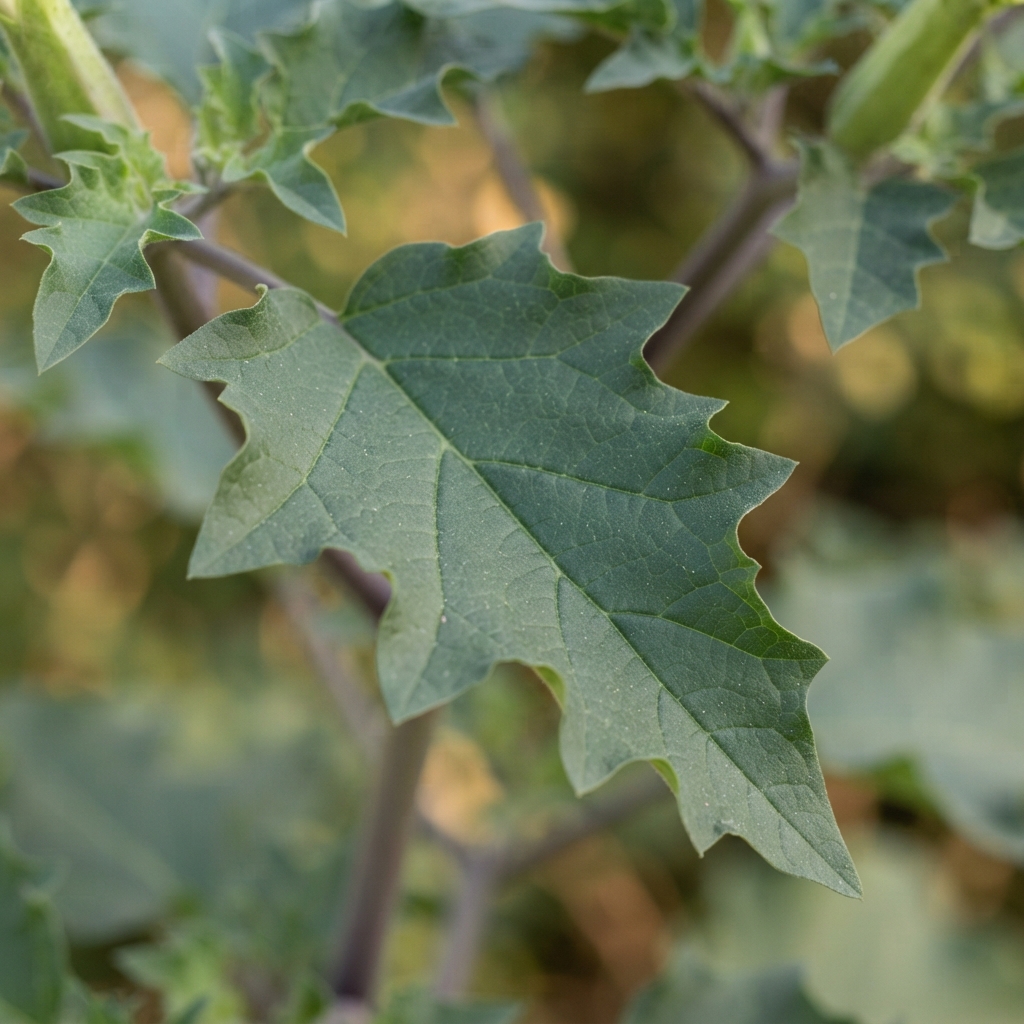
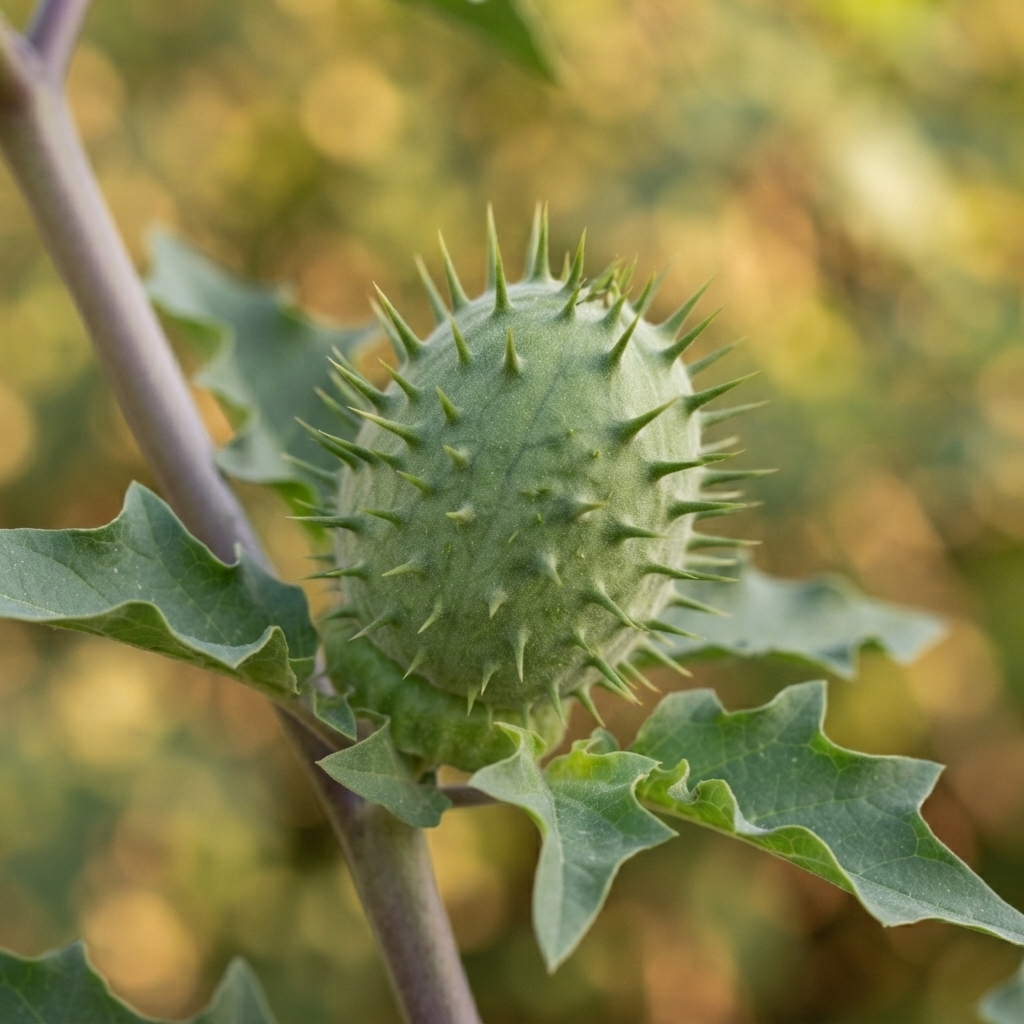
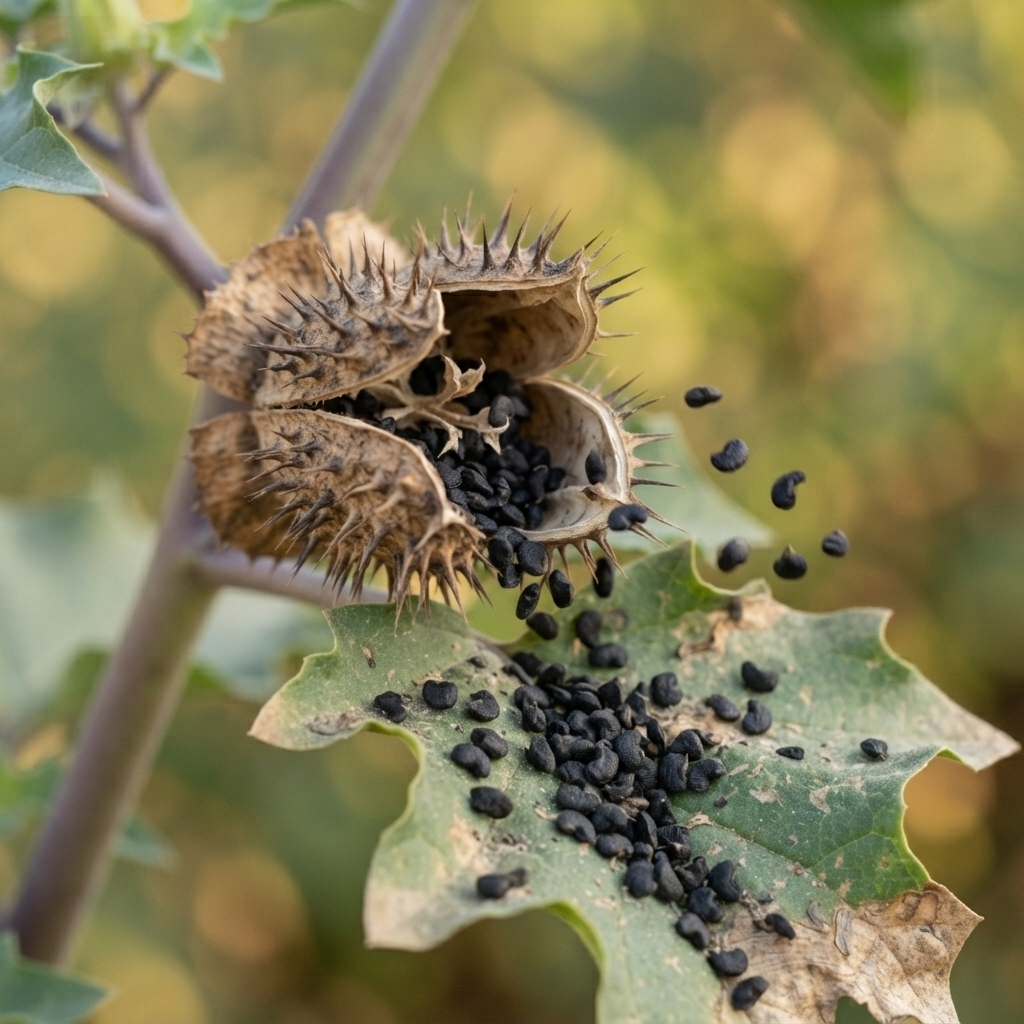
The whole plantThe flowerThe leafThe spiny fruitThe seeds
Hover over the prism to pause it.
A traveller from afar
The datura we find around here is Datura stramonium, known in English as thorn apple, jimsonweed or, more ominously, devil's trumpet. It belongs to the nightshade family (Solanaceae), like tomatoes, potatoes… and deadly nightshade. A family that holds the very best and the very worst!
Botanists long argued about where it came from, but most now agree on Central America, around Mexico. Native American peoples knew it well and used it with extreme caution, in rituals reserved for shamans.
The plant crossed the Atlantic in the 16th century, in the wake of the great voyages of exploration. In Europe it was first grown as a curiosity in botanical gardens and in apothecaries' herb gardens. Its sinister reputation followed it: it was linked to witches, potions and the "flying ointments" said to send them off on their broomsticks. Then, quietly, it escaped from the gardens and made itself at home along paths, on rubble and in cultivated fields, in France as elsewhere.
For a long time, medicine actually used it: until the late 20th century, French pharmacies still sold "anti-asthma cigarettes" made from thorn apple leaves! They have since been withdrawn, and rightly so.
A little anecdote: the American name jimsonweed is a corruption of "Jamestown weed". In 1676, soldiers sent to Jamestown, Virginia, are said to have eaten the young shoots as a salad… and to have spent several days in such a spectacular state of delirium that the story went down in history.
How does it grow?
Identity card
Type: annual plant (it dies with the first frosts, but its seeds stay behind).
Height: from 30 cm to over 1.5 m, heavily branched, with a hollow stem often tinged with purple.
Leaves: large, with irregular teeth, giving off an unpleasant smell when crushed.
Flowers: white (sometimes mauve), long funnels 6 to 10 cm long, opening mostly in the evening. Flowers from July until the frosts.
Fruit: a capsule covered in spines, about the size of a walnut, splitting into four when ripe.
Seeds: small, black, kidney-shaped, several hundred per capsule.
Datura is an opportunist. It loves disturbed, rich, sunny soil: vegetable gardens, field edges, waste ground, heaps of earth… and plots that are no longer looked after. It germinates late, once the soil has warmed up (from May to July), which lets it escape spring weeding.
Its real strength lies in its seeds. A single vigorous plant can produce several thousand, and they can stay alive in the soil for decades, waiting patiently for a spade to bring them back to the light. In other words: one plant left to go to seed this year means an infestation for the next ten or twenty years.
Why is it so dangerous?
Every part of datura (roots, stems, leaves, flowers and above all the seeds) contains tropane alkaloids: atropine, hyoscyamine and scopolamine. These substances disrupt the nervous system, and the amount in a plant varies enormously from one specimen to another, which makes any ingestion unpredictable.
⚠️ Signs of poisoning
very dry mouth, intense thirst;
dilated pupils, blurred vision, sensitivity to light;
flushed face, hot and dry skin, fever;
racing heart;
agitation, confusion, hallucinations, sometimes seizures.
Doctors sum up these symptoms with a famous saying: "dry as a bone, red as a beet, blind as a bat, mad as a hatter".
If in doubt, immediately call a poison control centre or the emergency services (15 or 112 in France), even if the person seems fine.
Those most at risk are children, drawn to the pretty flowers and "hedgehog" fruits, and also animals: dogs, horses, cattle, poultry. And the danger doesn't stop at the garden gate: datura seeds can get mixed into harvests of maize, buckwheat, soya or beans. In France, several batches of buckwheat flour and canned vegetables have already been recalled for this reason.
Finally, some people try to use it "recreationally". That is a very bad idea: poisonings are common, often serious, and the delirium it causes is described as terrifying.
And what about compost?
This is a key point for our association: datura does not go in the compost, unless it is pulled up young, well before the fruits form. In a garden compost bin, the temperature does not stay high for long enough to destroy the seeds. The result: you spread the plant all over your vegetable patch with your compost!
Plants in flower or in fruit should go into a closed bag, with household waste or to the recycling centre, making clear that they are poisonous plants.
The right moves… and a call for volunteers!
🌱 How to pull up datura safely
wear gloves and long sleeves;
pull it up before the fruits form, ideally in June or July, while the plant is young;
pull the whole plant out with its root; it's easier when the soil is damp;
don't touch your eyes or mouth while working, and wash your hands thoroughly afterwards;
bag the plants straight away, especially those already bearing capsules;
go back several times during the season: seedlings come up in waves.
The new plot taken over from the wastewater treatment plant is a blank page: bare soil, plenty of sun, no competition… If nobody looks after it, datura won't ask our permission before moving in. And every plant we miss means years of extra work, right next to our swaths.
The good news is that we are starting from scratch. Regular checks from next spring, a few rounds of pulling before the fruits form, and the plot will stay clean. With several of us, it goes very quickly.
So when the call goes out for the next clean-up morning, get your gloves out! A coffee, a bit of good humour, and we'll soon have our plot back doing what it's meant to do: producing lovely soil, not devil's trumpets.
Thanks for the gift… but no thanks! Or how a few dog poo bags ruined our volunteers' morning.
Dear fellow composters,
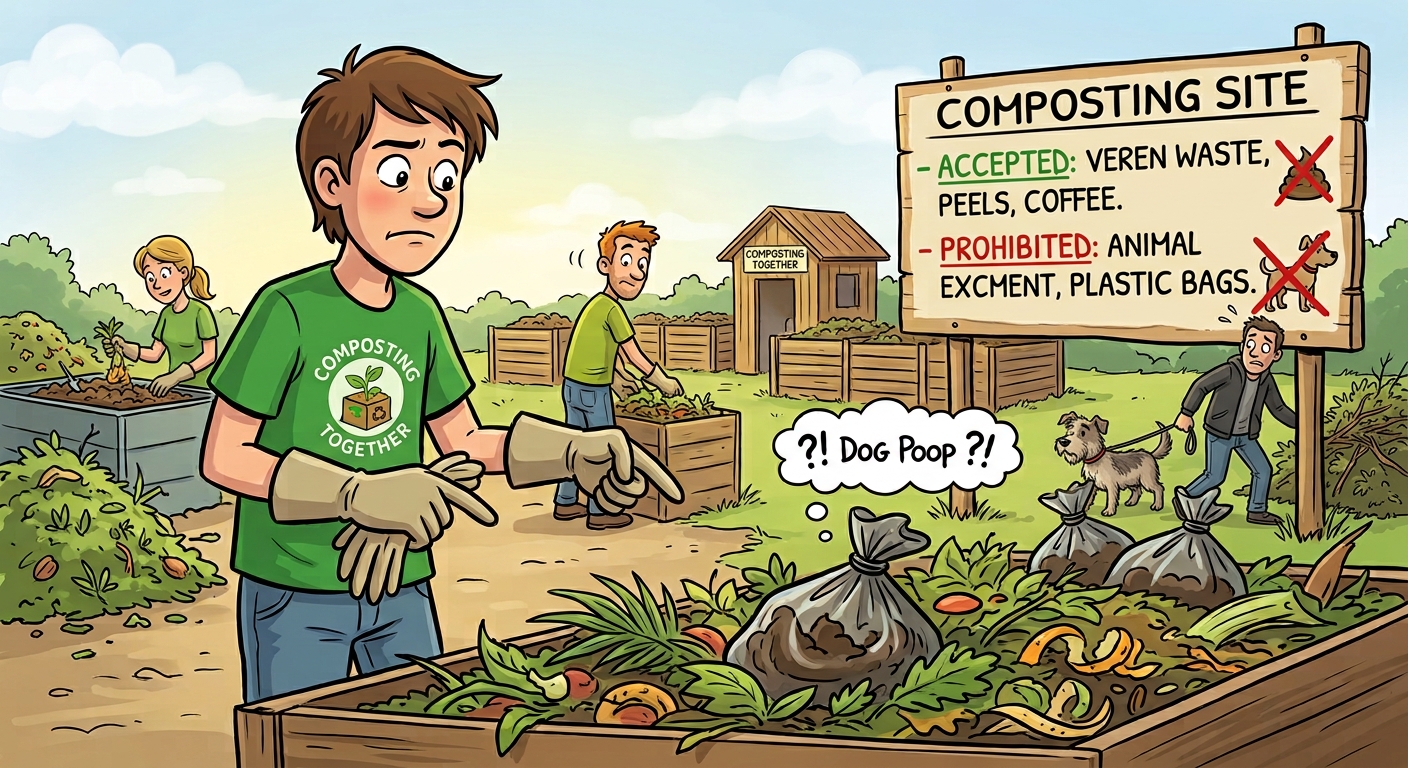
A few days ago, our volunteers got a surprise. Not a basket of vegetables, not a thank-you note, no: several dog poo bags, carefully filled and carefully tied, left in the middle of the garden waste at the platform.
A true story (more or less) from the Grosbreuil platform…
Let's start with the congratulations, because they are deserved: you pick up after your dog. Well done, honestly. The pavement thanks you, and so do passers-by's shoes.
It's the next step in the reasoning that escapes us. Someone thought: "Poo is natural. Natural things compost. Off to the platform it goes!" The plastic bag was presumably considered gift wrapping.
🚫 So let's state the obvious
🐕 No animal droppings
Neither dog nor cat, neither in the garden waste nor in the windrow. They can carry parasites and bacteria that have no place in a compost meant for our vegetable gardens, including the school children's garden.
🛍️ No bags
Plastic, "biodegradable", "compostable": all refused. They don't break down in our compost and end up as confetti in the soil.
🐈 No pet litter
It's already on our list of refused items. Poo in a bag is the same thing… with plastic as a bonus.
🧤 And now, who deals with it?
Our volunteers do. They didn't sign up to rummage through garden waste looking for suspicious little bags and pull them out by hand. They give their time, their energy and their mornings so that Grosbreuil has a clean platform and quality compost, open to everyone.
Respecting volunteers: is it really that hard?
Doing it right takes three seconds: the poo bag goes in the general household waste bin. Not in the compost, not in the garden waste, not in the windrow. The list of accepted items is displayed on site and available in our "What can be composted in Grosbreuil?" sheet (in French).
❓ Not sure? Just ask!
Our volunteers welcome you at the hut on Wednesdays and Saturdays, from 10 am to 12 noon. You can also email us at This email address is being protected from spambots. You need JavaScript enabled to view it.. We'd much rather get a question than a bag of poo.
To the person (or people) behind this drop-off: we don't hold it against you personally… well, maybe a little. But we know you'll do better next time.
Thank you to the many, many people who sort their waste properly and make this project possible. 💚
🍂 Autumn: the season to get ready for… next summer!
Summer 2026: cracked soil, empty water butts, and a daytime watering ban. Here in inland Vendée, about ten kilometres from the coast, we watched the streams run dry and our vegetable patches gasp for water. Everything suggests that the summers ahead will look much the same. The good news? The battle for water is won now, in autumn. Here is our advice for turning your garden into a sponge before winter.
☀️ What summer 2026 taught us
This summer, the Préfecture had to bring in water restrictions from 10 July. In Vendée, almost all our tap water comes from reservoirs: when it doesn't rain, they empty. By early September, less than half of their capacity remained, rivers had run dry almost everywhere, and watering vegetable gardens was banned between 8 am and 8 pm.
Yet our little corner of Vendée has one advantage: the ocean keeps our winters mild, with few hard frosts, and most of our rain falls between October and March. The whole strategy fits in one sentence: catch winter rain and store it in the soil, so it can do its job in summer. And autumn is the perfect season for it.
"There's no drought for a living, well-covered soil… only bare soils that forgot to save for a rainy day." — our mascot, earthworm and part-time philosopher
🌧️ 1. Covered soil drinks the rain; bare soil lets it run away
Remember Laurent's rain simulator? The demonstration speaks for itself: on bare, compacted soil, water runs off and carries the earth with it; on covered soil full of earthworms, it soaks in and stays put. The first heavy autumn rains are on their way: don't leave a single bed bare.
🌿 Wood chips
Our home-made "sponge": 5 to 10 cm on the surface, never dug in. It builds humus and feeds soil fungi, which will hold water for you next summer.
🍁 Fallen leaves
Free and plentiful! Spread them over empty beds, around shrubs and perennials. A little wood chip or straw on top stops them blowing away.
🌾 Straw
To protect artichokes, dahlias or strawberries and to cover paths. The bales from our Straw Operation are waiting at the platform.
⚠️ Never burn garden waste! It's against the law, it pollutes… and it's throwing away the best mulch there is.
Well-rotted manure: 3 to 5 kg/m², on the surface, without digging it in. Earthworms will do the work all winter… and dig tunnels along the way that let the rain soak in.
Mature compost: 2 to 4 kg/m² on beds that will host hungry crops in spring (tomatoes, squash, courgettes).
No manure where carrots, onions, garlic, potatoes or legumes will grow.
Why does it matter so much in a drought? Because organic matter is a water reservoir: a humus-rich soil can hold several times its own weight in water, whereas a poor soil loses it within days.
🌱 3. Sow green manures: roots that work for you
A bed standing empty until spring? Sow it before mid-October. These plants cover the soil, catch the rain, stop nutrients from being washed away and structure the earth with their roots.
Phacelia: grows fast, rarely freezes here, and bees love it.
Rye + vetch mix: the classic winter cover, very dense.
Field beans: their deep roots break up clay soils and add nitrogen.
In spring, cut them down and leave them on the surface as mulch. No digging needed: Laurent would approve!
🌳 4. Plant trees, hedges and fruit trees: your anti-heatwave investment
The old French saying goes: "On Saint Catherine's Day, every twig takes root" (25 November), and it has never been truer. A tree planted in autumn has the whole winter to settle its roots thanks to the rain, and will face its first summer far better equipped than one planted in spring, which would need watering all summer long… if watering is still allowed.
For a drought-tolerant hedge that is good for wildlife, choose local species: field maple, hawthorn, blackthorn, common dogwood, spindle, wild privet, and, on the lighter soils nearer the coast, holm oak or strawberry tree. For fruit, the heritage varieties of the Pétré Conservation Orchard, selected over generations for our climate, are a safe bet.
A hedge also means shade and shelter from the wind: less wind means less evaporation in the vegetable patch.
Tip: shape a small basin around the young plant, water generously at planting (with rainwater!), then mulch widely: 10 cm of wood chips over a one-metre circle.
🥬 5. The autumn-winter vegetable patch: make the most of the wet season
With our mild winters, the vegetable garden doesn't stop in October. Even better: winter crops thrive on free rainwater.
Task
What
Why it's clever
Sow / plant
Broad beans, garlic, shallots, white onions, winter peas
Harvested in May–June, before the heat: no summer watering at all.
Sow
Lamb's lettuce, spinach, winter radishes
They love the cool, damp weather.
Plant
Cabbages, leeks (last plantings)
Winter harvests, watered by the sky.
Divide
Rhubarb, chives, strawberries (runners)
Perennials root themselves over winter.
💧 6. Collect rainwater… before it falls
This summer, many people in Vendée rushed out to buy a water butt. The right time to install one is now, so it fills up with autumn and winter rain.
The maths is simple: 1 mm of rain on 1 m² of roof = 1 litre. A 10 mm shower on a 50 m² roof already gives you 500 litres!
Link several butts together, keep them covered (tiger mosquitoes and algae), and place them close to the vegetable patch.
A pond, however small, stores water, cools the garden and attracts frogs and toads, great slug eaters.
For next summer, get some ollas ready (buried terracotta pots) or a drip system: water goes straight to the roots, with no waste.
♻️ 7. The compost bin in autumn: don't miss the "browns" festival
After a dry summer, many compost bins are too dry: nothing breaks down. Water them with rainwater until the contents feel like a wrung-out sponge.
And stock up on fallen leaves! They are carbon-rich "brown" materials, precious all year round to balance out kitchen peelings. At the platform too, the windrow is short of them: 1 volume of food caddy for 3 volumes of wood chips is the rule.
Keep a pile of leaves and branches in a quiet corner: it's a winter hotel for hedgehogs, who will rid you of slugs in spring.
Don't cut back all the dry stems: many helpful insects spend the winter inside them.
When the leaves fall, look up: this is when Asian hornet nests become visible high in the trees. Don't destroy them yourself; report them to the town hall. Trapping comes in spring (see our hornet trap guide).
🗓️ 9. Start planning summer 2027 now
Autumn is also the time to review the summer, while it's still fresh in your mind:
Which plants coped? Note the varieties that stood up to the heat and save their seeds for the Seed Swap and next spring's Plant Swap.
Group thirsty crops (tomatoes, courgettes, cucumbers) close to your water supply, and plan some shade.
Bring the calendar forward: plant earlier in spring, so you harvest before the July heatwaves.
Less lawn, more ground cover: a lawn that turns yellow in summer recovers with the rain, so there's no need to water it.
Install water butts · sow green manures and lamb's lettuce · re-moisten the compost bin
October
Mulch every empty bed · spread manure and compost on the surface · plant garlic and shallots · last green manures
November
Plant hedges, trees and fruit trees (Saint Catherine's Day!) · sow broad beans · store fallen leaves
December
Rotted manure on next year's beds · protect tender plants · plan summer 2027
📍 Stock up at the Grosbreuil platform
As a member (€2 a year), you can collect wood chips, compost, manure and straw bales (€2.50 each) to get your garden ready for the dry season.
Open Wednesdays and Saturdays, 10 am to noon · stock varies · Join the association
With the climate changing, we can't make it rain (except Laurent, with his simulator). But we can make every drop count. So this autumn: cover, feed, plant, store. Your garden will thank you in July! 🌱
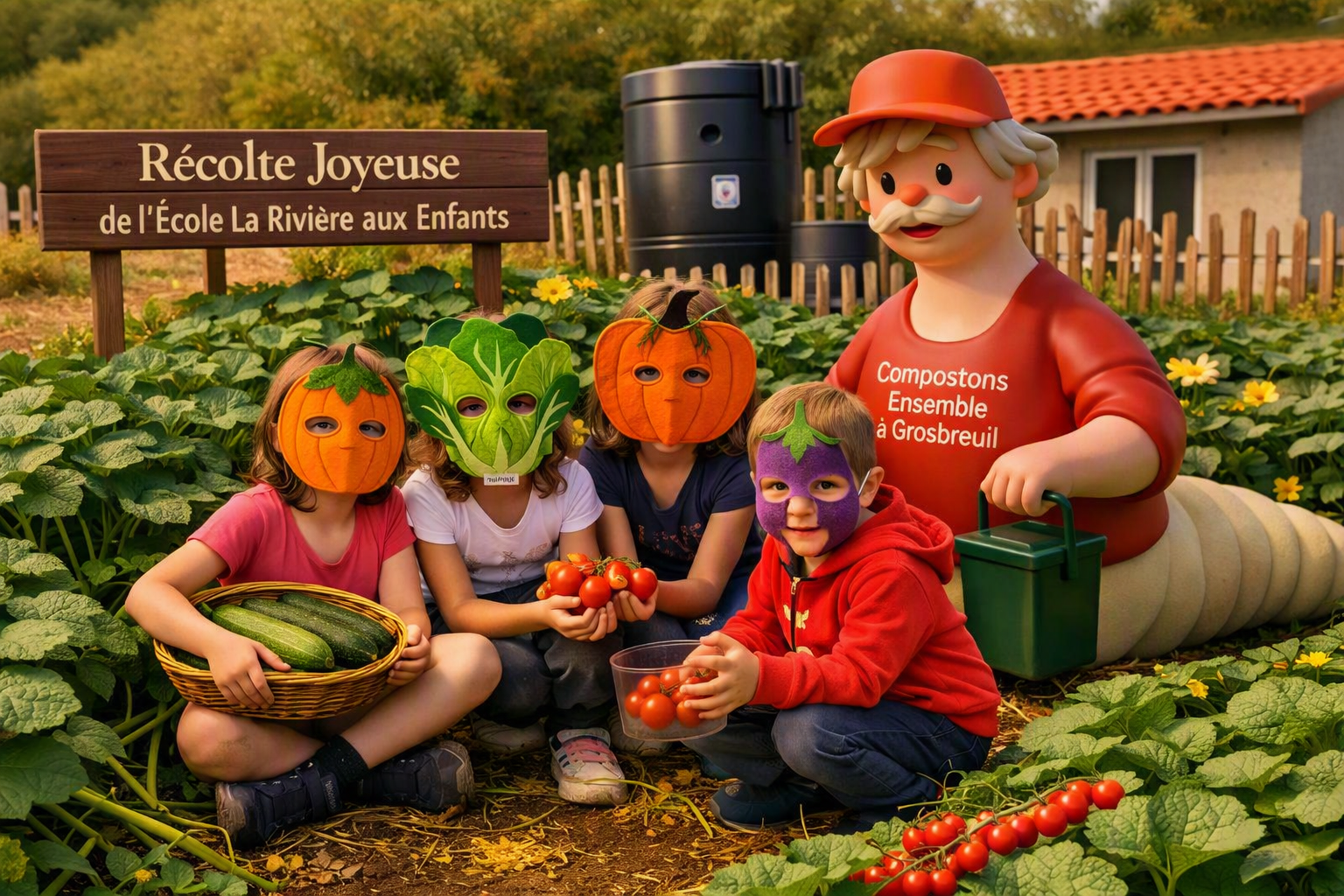
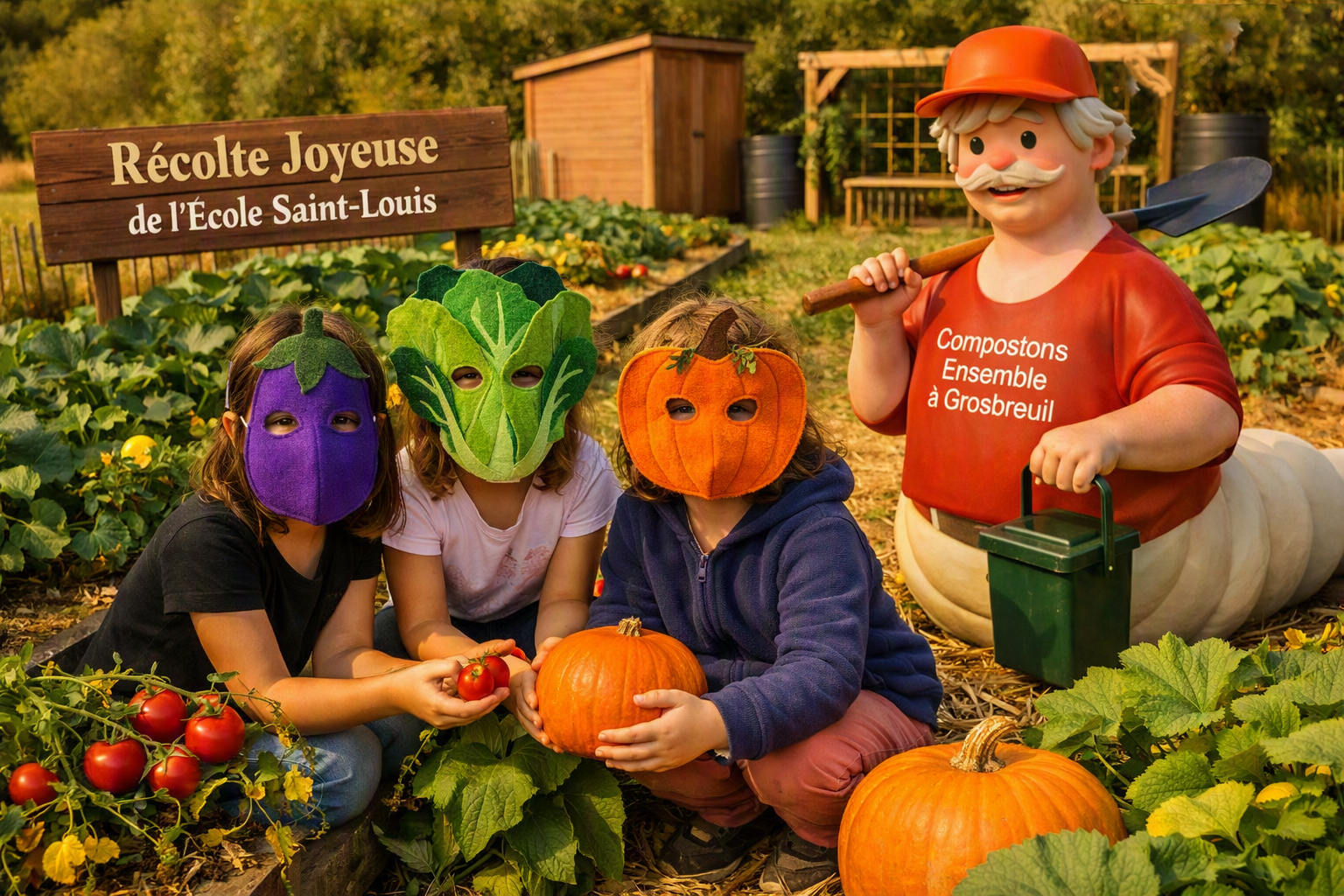
The nursery pupils of La Rivière aux Enfants and their harvest of courgettes and tomatoes.The nursery pupils of Saint-Louis, proud of their pumpkin and cherry tomatoes.
Garden alert in Grosbreuil! In recent days, masked figures have been spotted lurking between the rows of courgettes. Pumpkins, aubergines, even a lettuce on legs… After a thorough investigation, our mascot has unmasked the culprits: the budding gardeners of the state school La Rivière aux Enfants and of Saint-Louis school! 🎃🍆🥬
Take a good look at the photo above: both gangs of veg-snatchers appear in turn, caught red-handed with their baskets. Want a closer look at the suspects? Just hover your mouse over the picture (or tap it) to freeze the line-up!
A shared garden, like a good cake
Come spring, the school garden made plenty of people happy. This year, three groups wanted to get their hands dirty: the two schools and the local children's holiday club (the accueil de loisirs). No squabbling: we shared! Half a bed for the state school, half a bed for Saint-Louis, room for the holiday club… and the bed at the back set aside for squashes. That's the kingdom of pumpkins and other "giant" vegetables, and its harvest will be shared among everyone.
Team one: La Rivière aux Enfants
At the end of May, the nursery pupils and their teacher Christelle Langevin came to plant their autumn vegetables. They even brought their own seedlings! In September, surprise: big, plump courgettes, tomatoes as red as clowns' noses, and five or six little pumpkins and butternuts just starting to show. In the photo, the basket is overflowing: we very nearly had to call in a wheelbarrow for backup!
Team two: Saint-Louis
The nursery pupils of Saint-Louis school, with their teacher Audrey Fetiveau, came along as early as May to prepare the ground. In September, they carefully picked cherry tomatoes and, above all, a magnificent pumpkin, carried like treasure. When their photo fades in, one question springs to mind: which is more orange, the pumpkin or the mask?
Well done, children!
You weeded, you planted, you waited (sometimes impatiently!), and the garden said thank you. These vegetables are now off to the classroom for more discoveries. Keep your eyes, and your taste buds, wide open: the garden still has plenty of surprises in store!
Thank you to the teachers… and to Benoît!
A huge thank you to our teachers, Christelle Langevin and Audrey Fetiveau. Despite a very busy month of May, they found the time to bring their pupils to the garden. They turn every outing into an adventure and give the children a taste for the soil, the seasons and sharing. Thanks also to Benoît Pichard and the holiday club team, who came to lend a hand with the youngest ones. They happily made do with whatever space was left!
Thank you to our volunteers, the unsung heroes (come rain or shine!)
A very special mention for Philippe Guilloteau, one of the founders of Compostons Ensemble and the children's garden's greatest ally. Before the classes even arrived, the beds had been weeded and mulched. He supplied the squash seedlings himself. He also laid a tarpaulin over the third bed to smother the invading chickweed. And when it comes to bindweed, Philippe never backs down! As he puts it himself, the association is delighted to help awaken the children's taste buds. 🍅
And all summer long, while the pupils were enjoying their holidays, the volunteers watered, tended and protected the vegetable patch. They prepare the gardens all year round, with good mature compost, so that the tiny seeds of spring can grow into these fine autumn harvests. Hats off, or rather caps off, just like our mascot!
Speaking of which, our mascot still can't get over it. An earthworm by trade, it has seen a great many vegetables go by, but rarely such fine gardeners. It looks forward to seeing you very soon for more garden adventures… masks optional, smiles compulsory! 🌱
What if your children learned composting… by playing? Compostons Ensemble is proud to unveil its latest creation: the Compost Game of the Goose, an online educational game for children aged 6 to 12, available right now on this website.
A 40-square journey through our composting site
The rules are those of the classic Game of the Goose, with a compost twist: roll the die, move your pawn, and meet everything that makes our composting site tick along the way. The kitchen caddy, the wheelbarrow, the sieve, the thermometer — and its residents too: ladybird, hedgehog, woodlouse, butterfly, and of course the indispensable earthworms, who grant precious extra turns!
Watch out for blunders, though: a plastic bag thrown in the bin, meat where it doesn't belong, or compost left too dry will send you backwards or make you skip a turn. Just like in real composting life, good habits move you forward.
The mystery word: the real key to victory
Moving forward is not enough! To win, you must discover the 8-letter mystery word by answering questions about composting. Eight "LETTER ?" squares punctuate the route: each correct answer reveals one letter.
And the word changes every game!TOGETHER, WOODLICE, MULCHING, BACTERIA… a whole pool of composting words hides inside the game. Plenty of reasons to play again and again while growing your composter's vocabulary.
Can you beat The Mascot?
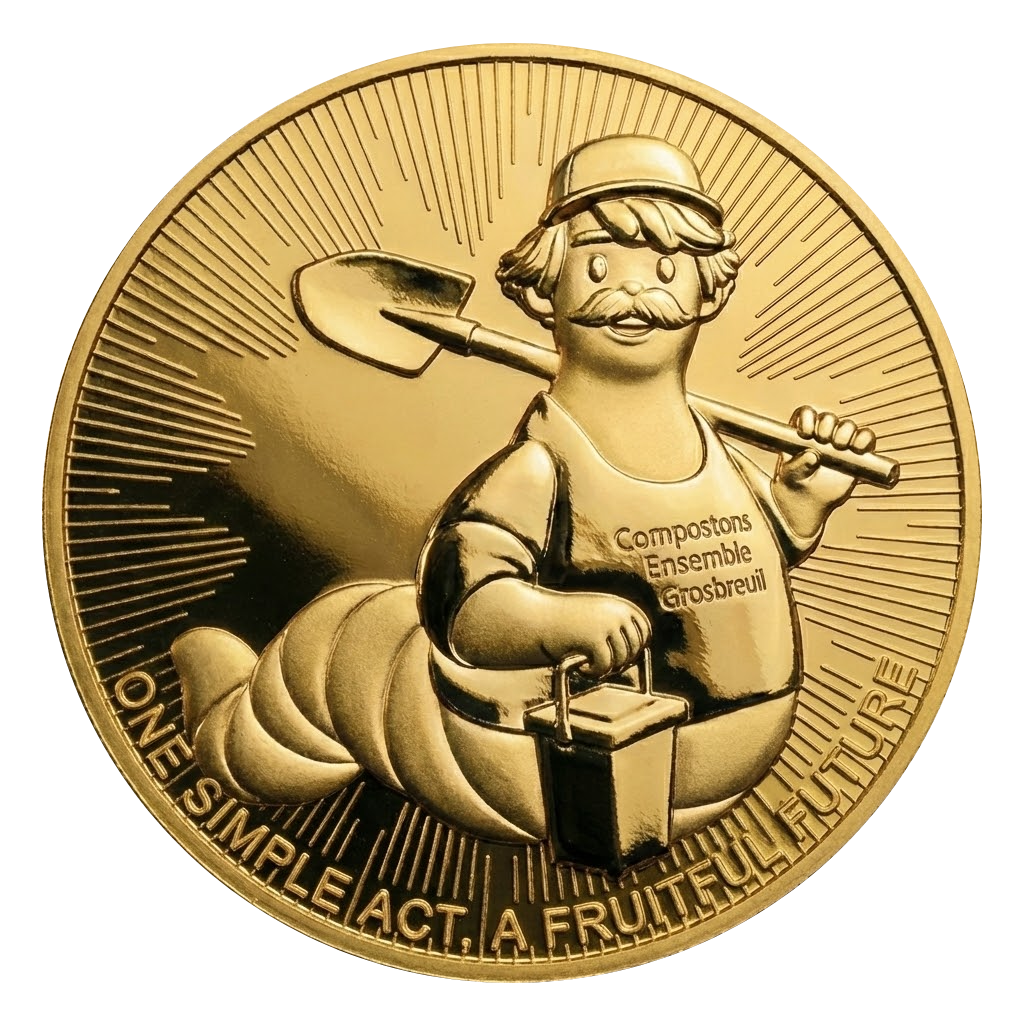
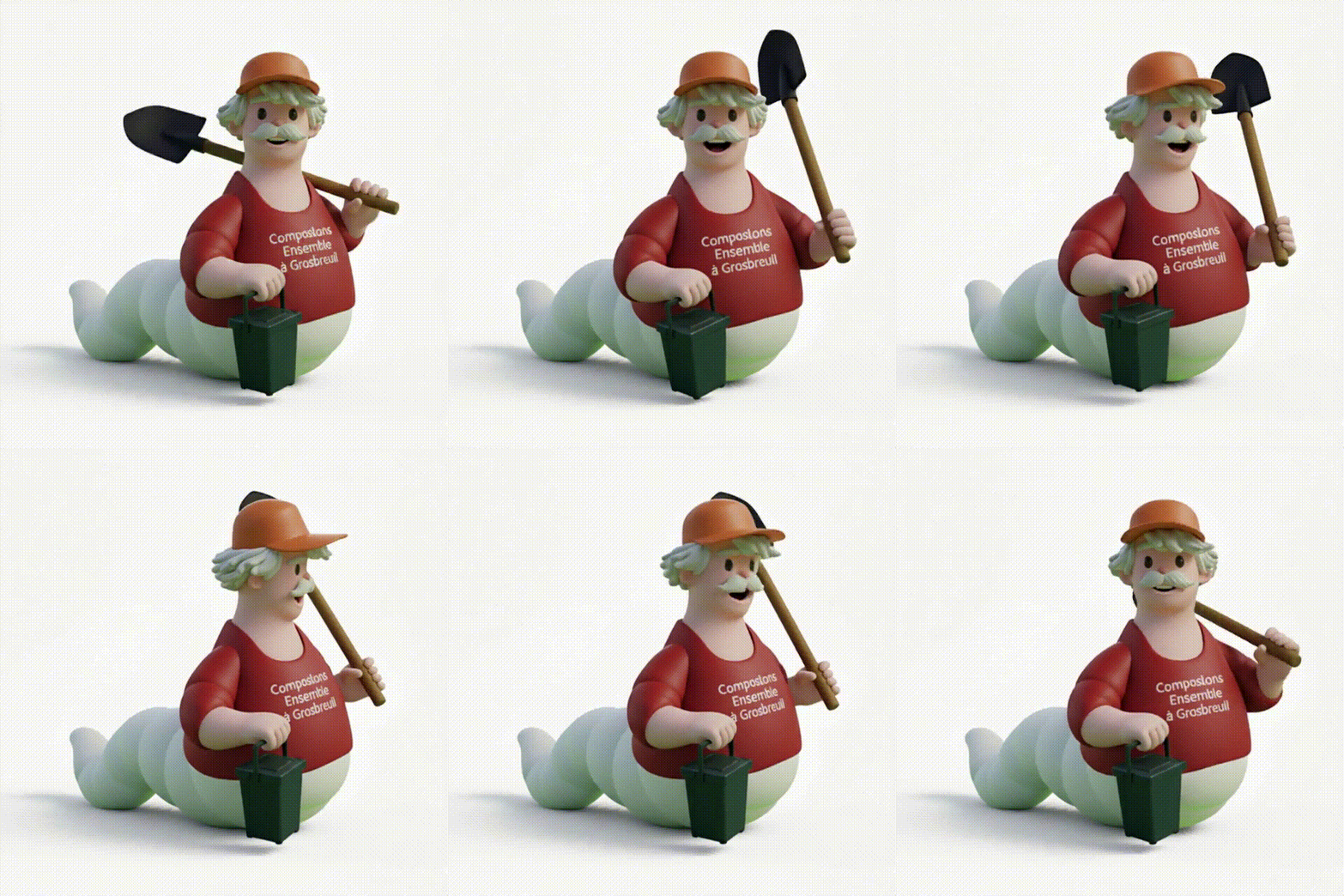
Every game pits you against the association's Mascot, our moustachioed cap-wearing worm, who rolls the die and answers questions like a real player — and he knows his compost well! Two question levels are available: ages 6–8 and ages 10–12, and the game is fully bilingual French-English.
Teachers, youth leaders, parents: the game is freely accessible for any educational activity, in class or at home — all you need is a web browser, nothing to install. A game lasts 20 to 30 minutes and covers the essentials: what can and cannot be composted, the balance between green and brown materials, the role of the little creatures, and the good composter's habits.
The game is available at any time from the site menu, under the Tools & games tab.
The Compost Game of the Goose joins our family of fun learning tools, alongside the compost quiz and Docteur Compost, our online assistant. Because here in Grosbreuil, we are convinced of one thing: sorting and composting habits are best learned when we discover them together… now that would make a nice 8-letter word, wouldn't it?
Enjoy the game, and see you soon at the composting site!
On 26 June, the "La Rivière aux Enfants" school held its end-of-year fête. And this year, the party had a quiet but essential guest: composting!
A show performed by the children, food and drinks, upbeat music, and even the big match on a giant screen: the Amicale Laïque de Grosbreuil (the school's parents' association) pulled out all the stops for the public school's end-of-year celebration. Young and old danced the evening away in a wonderful atmosphere.
But amid all the excitement, the Amicale's volunteers didn't forget a gesture close to our hearts: sorting the fête's food waste and bringing it to the community composting site. Kitchen peelings, leftover meals… nothing went to waste!
The fête in numbers
140pupils
38volunteers
14partners
400+meals served
25home-made cakes
4goals on the big screen
14 kgof food waste composted!
Yes, you read that last line correctly: 14 kilos of food waste were collected during the fête and dropped off at our composting site. In a few months' time, they will have turned into quality compost that will return to nourish the soil of Grosbreuil. The loop is closed!
Welcome to the Amicale Laïque, our newest member!
We are delighted to announce that the Amicale Laïque de Grosbreuil — the volunteer parents' association of the "La Rivière aux Enfants" school — has joined Compostons Ensemble. This membership is special to us: beyond individual habits, it is a whole local association committing to recycle its food waste at every event, setting an example for families and children alike.
Does your association organise events in Grosbreuil too? Fêtes, meals, markets… your food waste belongs at the composting site. We'll gladly help you set up the sorting: get in touch!
As every year, the call of the straw echoed across Laurent and Catherine's field. And as every year, the members of Compostons Ensemble answered the call: up to 16 brave volunteers swapped their deckchairs for pitchforks. This year, the heatwave set the tempo: the wheat was cut much earlier than usual. The weather decides, we adapt — that's composting life for you.
A star born in 1975 (with a temperament to match)
A round of applause for the star of the day: Didier's baler — he owns her, and lends us both his machine and his muscle every year. Born in 1975, she has quite a personality — let's just say breakdowns are part of her charm and she likes to keep us guessing. But Didier has been taming her for years: he knows every one of her whims, every bolt, every mood. The result on the big day: she only acted up twice! For a 51-year-old lady working in a heatwave, that counts as a stellar performance — and a flawless run for her dedicated handler. Between two tantrums, she purred along, swallowed the straw and spat out perfectly square bales — a true joy of old-school mechanics.
Muscles, pitchforks and a trailer
Then came the sporting event: loading the trailer using nothing but our pitchforks and our arms. No robots, no artificial intelligence — just collective intelligence and a few sore muscles to come. Bales flew, piled up, and the straw pyramid rose towards the blue Vendée sky.
Next stop: the platform, to unload the whole lot. And hats off here: a team of valiant handymen, led by the brilliant Jean-Luc, had prepared a storage area on wooden pallets beforehand. Top-level logistics — our bales will spend the winter dry and well off the ground.
The transport parade
A special mention for the arrival procession, worthy of a rural elegance contest: Jacques came by bicycle, Didier caused a sensation on his Solex (vintage helmet included, see photo — pure class), others arrived by tractor or, more conventionally, by car. Not all CO₂ emissions were created equal, but all the goodwill certainly was!
And to finish… lunch!
Naturally, it all ended the way it should: with a friendly meal organised by Catherine. Because at Compostons Ensemble, we know it well: straw feeds the compost, but it's conviviality that feeds the association.
A big thank-you to Laurent and Catherine for the field and the welcome, to Jean-Luc and his team for the platform, and to all the bale carriers, cyclists, Solex riders and tractor drivers. See you next year — the straw waits for no one!
But wait… what is all this straw actually for?
Good question! Now that the bales are waiting patiently on their pallets, here's a little reminder for gardeners, composters, and anyone who thought straw was only good for hats and scarecrows.
1. Mulching: a duvet for your vegetables
Spread a good layer of straw (8 to 10 cm) at the foot of your tomatoes, courgettes and other thirsty ladies, and watch the magic happen:
Water stays put. Under the straw, the soil keeps its moisture. With the summers we're being served these days, that's every other watering saved — and your back will thank you.
Weeds throw in the towel. Deprived of light, they give up before the match even starts. Less hoeing, more napping.
The soil stays alive. Earthworms, insects and micro-organisms settle in under this thatched roof as if it were a four-star guesthouse. And living soil means a thriving vegetable patch.
2. In the composter: straw is "brown" gold
You know it (or you're about to): good compost is a balance between green materials (peelings, grass clippings, moist scraps) and brown materials (dry and rich in carbon). And straw is a champion of the brown category!
A handful of straw on top of your kitchen waste, and presto:
No more smells — straw aerates and absorbs excess moisture.
No more compacted heap that looks like soup. Structure returns, air circulates, bacteria breathe.
Fruit flies sulk. A layer of straw on top, and the open-air buffet closes its doors.
That's exactly why our bales are waiting nice and dry on the platform: they're available to members to feed the composters all year round.
3. Strawberries live up to their name
Quick culture break: the English word strawberry literally means "straw berry" — and it's no coincidence! A bed of straw under your strawberry plants keeps the fruit clean, dry, and out of reach of slimy slugs. Your strawberries will thank you in June.
4. And also…
Clean paths between the rows of your vegetable garden: no more muddy shoes.
Winter protection for tender plants (artichokes, dahlias… tuck them in like grandma used to tuck you in).
A shelter for hedgehogs in a quiet corner of the garden — they'll rid you of slugs in exchange for the rent.
To sum up
Straw is the ultimate zero-waste champion: it protects, it feeds, it saves water, and it ends its life as compost. The loop is closed — and at Compostons Ensemble, we love a closed loop.
Bales are available at the ridiculously low price of €2.50 each — cheaper than a coffee on a café terrace, and considerably more useful for your tomatoes. Enough to cover the costs, with the rest going straight into the association's kitty.
So help yourselves (within reason — leave some for your friends) and happy mulching!
Is the windrow not heating up? The most likely cause is a lack of carbon. Wood chips are essential to balance the nitrogen-rich food scraps. Please always respect:1 part caddy waste + 3 parts wood chips
💡 Did You Know?
Composting means taking concrete action for the planet!
The Réseau Compost Citoyen works to place community composting at
the heart of organic waste management. A national network bringing
together associations and local authorities around sustainable and
community-minded practices.
The Verger Conservatoire de Pétré is committed to preserving, promoting
and sharing local fruit tree genetic heritage. A wonderful initiative
protecting the varietal biodiversity of our Vendée region.
The Association for the Promotion of Sustainable Agriculture advocates
for farming practices that respect soil health and the environment —
perfectly aligned with our values of composting and organic recycling.
The Vendée Grand Littoral community of communes supports local
environmental and sustainable development initiatives. Their backing
enables us to roll out shared composting sites across the whole territory.
The municipality of Grosbreuil has been our local partner since the
association was founded in 2009. The town provides sites for our shared
composting locations and supports our awareness-raising activities
among residents.
A Grosbreuil-based roofing and waterproofing contractor, D.C.E shares
our commitment to the local area and the common good. This neighbour
and supporter gives practical backing to our community composting
initiative right here in the village.